
HR Transformation Starts Here

HR Transformation Starts Here
A practical guide to getting ready before you change a thing
Most organisations don’t wake up one morning and decide to transform HR. It creeps up on you. Reports take an age to pull together, payroll starts to feel like a monthly act of bravery, and your team spends more time wrestling with the system than getting anything useful out of it. Eventually someone says it out loud: we need to do something about this.
That’s usually the moment the conversation leaps straight to software. Which platform? How quickly can we go live? It’s an understandable instinct, but it skips the question that matters most: is your organisation actually ready for change?
We ask it a lot at Team Wheel, because we’ve seen what happens when it goes unanswered. Organisations move quickly into selection or implementation without really understanding their current processes, data, governance and ways of working. The result is rarely the fresh start they hoped for. More often, they pour time and budget into an expensive new platform, only to rebuild the same broken processes inside it. The technology is shiny and new. The problems, sadly, are not.
A readiness assessment is how you avoid that. It’s a chance to step back before the big decisions are made and get an honest picture of where you stand: what’s working, what needs attention, and what will genuinely help your transformation land.
What is an HR transformation readiness assessment?
Put simply, it’s a structured review of your current HR and payroll environment. It looks across the four things that really make transformation work, namely your people, processes, systems and data, and identifies what’s running well and what needs attention before you change anything.
It isn’t about adding complexity or producing a report that gathers dust on a shared drive. The point is practical: to make sure you go into transformation with your eyes open and a realistic plan in hand.
A good assessment helps you answer the questions that tend to get glossed over in the rush to implement:
- Are our HR and payroll processes consistent and clearly defined?
- Do we actually trust our data?
- Are our systems supporting the business, or quietly working against it?
- Is leadership genuinely aligned on what transformation is for?
- Do we have the right people internally to support the change?
- Are managers and employees ready to work in new ways?
These aren’t side issues. They’re the foundations everything else is built on.
Why readiness matters
Here’s the uncomfortable truth: technology on its own doesn’t fix operational problems. If your processes are unclear, your data is inconsistent or nobody’s quite sure who owns what, a new system won’t make those issues disappear. It will simply move them somewhere new and often make them harder to spot.
The wider research points the same way. The CIPD’s work on HR operating models keeps landing on the same idea: successful transformation depends on digital capability, employee experience and organisational alignment working together, not on technology alone. The organisations getting the best results have stopped treating transformation as an IT project and started treating it as a people-and-process one.
In our experience, the difference almost always comes down to preparation. The teams that take the time to get ready before implementation begins are the ones who sidestep the expensive surprises later.
Five areas to review before you start
A readiness assessment can cover a lot of ground, but five areas do most of the work. Here’s where we’d encourage you to look first.
1. Business goals and leadership alignment
Every transformation needs a reason for being, and ideally one everyone at the top agrees on. For some organisations it’s efficiency. For others it’s better reporting, stronger compliance, a smoother employee experience, or systems that can keep pace with growth. None of these is wrong. The risk is when different leaders are quietly pulling in different directions.
Worth asking:
- Is there a clear, shared reason for transforming?
- Have you agreed what success actually looks like?
- Are your business leaders genuinely behind the programme?
- Is there a realistic roadmap and timeline?
Without clear direction, even well-funded projects tend to drift.
2. HR and payroll processes
A lot of organisations are held together by manual workarounds, spreadsheets and the same task being done three times by three different people. Before you bring in new technology, it’s worth understanding how your processes really work today, and whether they’re worth carrying forward.
- Areas usually worth a closer look:
- Recruitment and onboarding
- Payroll workflows
- Absence management
- Reporting and approvals
- Employee lifecycle processes
- Manager self-service
Tidying up your processes before implementation almost always pays off. It’s far easier to streamline something on paper than to untangle it inside a live system.
3. Data quality and reporting
Data is the quiet make-or-break of every transformation. If your employee records are incomplete, duplicated or inconsistent, your reporting can’t be trusted and your implementation gets harder at every turn.
A readiness assessment should take a clear-eyed look at:
- Data quality
- Reporting requirements
- GDPR and compliance considerations
- Ownership and accountability
- How well your systems integrate
- The risks around data migration
Get your data into good shape and everything downstream becomes easier, including the confidence to make decisions based on what your numbers are telling you.
4. Technology and systems
Most organisations don’t have a single system so much as a collection of them, stitched together over the years. Each one made sense at the time. Together, they often create duplicated admin, inconsistent reporting and a frustrating experience for the people using them every day.
A technology review helps you see clearly:
- What’s genuinely working today
- Where systems are creating friction
- Which processes could sensibly be automated
- Whether your systems can support where the business is heading
- How well everything connects
The aim isn’t to rip everything out and start again. It’s to build a more joined-up HR and payroll environment, and to get more from the platforms you already have.
5. Change readiness
Transformation succeeds or fails on people just as much as technology. Your HR team, your managers and your wider workforce all need support to make the shift, and that takes clear communication, honest expectations and real engagement, not a single all-staff email the week before go-live.
Worth thinking through:
- Is there a clear approach to managing the change?
- Do managers understand their part in helping people adopt it?
- Has communication been properly planned?
- Do you know what training will be needed?
- Is the organisation genuinely ready to work differently?
The more prepared your people feel, the more likely the whole thing is to stick.
A simple HR maturity model
It can help to put a name to where you are. The model below is deliberately straightforward: a quick way to gauge your starting point and spot where the biggest opportunities sit.
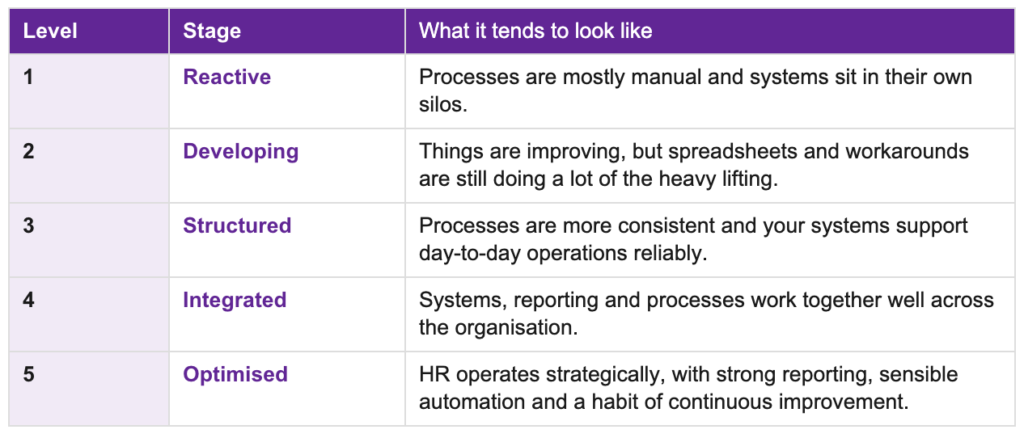
Most organisations land somewhere between Levels 2 and 4, and that’s perfectly normal. What matters isn’t reaching Level 5 overnight. It’s understanding what’s realistic for your business and where a little focus would make the biggest difference.
Signs you might need more preparation
A few patterns tend to show up when an organisation isn’t quite ready yet. If several of these feel familiar, it’s worth pausing before you press ahead:
- Spreadsheets and manual workarounds everywhere
- Little confidence in your reporting
- Unclear ownership of key processes
- Systems that don’t talk to each other
- Low engagement with the technology you already have
- Leadership that isn’t fully aligned
- Competing priorities pulling attention away
- Limited internal resource to support the change
Spotting these early isn’t a reason to lose heart. It’s exactly how you avoid the bigger, costlier problems later.
How Team Wheel can help
This is where we come in. We work alongside organisations to help them make informed, confident decisions about HR and payroll transformation. Our readiness assessments are built to give you clarity, reduce risk and leave you with a practical roadmap rather than a vague sense of unease.
We’re consultants, not a software vendor, so we’ve no horse in the race when it comes to which platform you choose. Our job is to understand your challenges, review how things work today and help you find the opportunities, working with your existing or planned systems, rather than pushing a product. The goal is to help you get the most from your HR technology investment and build something that genuinely works for your people and your business.
Final thoughts
HR transformation has never really been about installing a new system. It’s about shaping the processes, technology and ways of working that will support your organisation today and as it grows. A readiness assessment is simply the sensible first step: an honest look at where you are before you commit to where you’re going.
If you’d like that honest look, let’s talk. You’ll leave with more than a checklist. You’ll leave with a clear, practical plan you can act on.
References
Chartered Institute of Personnel and Development (CIPD). Transforming HR operating models. https://www.cipd.org/uk/views-and-insights/thought-leadership/insight/transforming-operating-models/
Chartered Institute of Personnel and Development (CIPD). Effective operating model transformation. https://www.cipd.org/uk/views-and-insights/thought-leadership/insight/effective-operating-model-transformation/
Chartered Institute of Personnel and Development (CIPD). Digital transformation in organisations and people functions. https://www.cipd.org/uk/views-and-insights/thought-leadership/the-world-of-work/organisations-people/
Get in touch to start the conversation. We’ll meet you where you are and help you move forward with confidence.
© 2025 Team Wheel. All rights reserved. This document and its contents are the intellectual property of Team Wheel. Reproduction, distribution, or use of any part of this document without the express written consent of Team Wheel is strictly prohibited.